Greetings patrons,
Every month I am inundated with things I have to read for class OR for teaching. For my own self-care & sanity I also read across texts I am more interested in whenever I get a quick 10-20 minute break from working. I do this two to three times a day, allowing me to get a chance to read a few news articles, a research article, & maybe a book chapter in addition to my course & workload.
My current readings list allows me to share not only what I’m reading but also my methods (how I read) & my thoughts on what I’m reading. Also my goal is to include some of my personal writings from my tedious collection of notes in these current reading posts so that you can get an even greater look into how I’m incorporating perspectives across different kinds of texts.
This month I am reading from three different books & one article:
1: “Anti-Racism” by Alex Zamalin
Zamalin is a political theorist who has written extensively on African American political thought, check out his 2017 book in .pdf format here for free: https://b-ok.cc/book/3598007/125cbd . I’m currently reading Chapter 2 “Rejecting the Power of Racism”. This text is a nice introductory read to some of the basics of the history of Anti-Racism and anti-racist political thought presented in one place. As of yet, Zamalin focuses on the ultimate dichotomy of race: whiteness & Blackness, though they also directly note that it is their focus in the text rather than an indication that other non-white colonized population’s respective racialized position are less important. Zamalin’s presentation of anti-racist thought & history is a nice presentation of the macro institutional & policies that go into making the typical “every day” reproduce itself through levels of organized human action. Systems become more clear as groups of individuals taking action day in and day out dependent upon the actions that came before them.
2: “The Source of Self-Regard: Selected Essays, Speeches, & Meditations” by Toni Morrison
Currently reading “The Foreigner’s Home” which is about Morrison’s grappling with the promises and plights of globalization, especially its threats to co-opt & Westernize all that we know as culture. Morrison’s apt descriptions of the modern world as nations developed & developing become Americanized illustrates the very relations that tie every individual to every other individual & to the collective forces of the history of human action. This first essay of Part 1 comes after Morrison’s Peril where she discusses the critical role & place of writers in society with respect to voicing the truth & hence frightening regimes of power.
3: “Everyday Practice of Race in America: Ambiguous Privilege (Postcolonial Politics)” by Utz McKnight
McKnight approaches theorizing the continued significance of race in a supposedly ‘post-racial’ society & amidst anti-racist social movements. This text is easier to understand if you have some background or content in contemporary sociological theory & critical race theory. What I’m enjoying most about this book (mind you, I’m still reading the first chapter) is its focus on the practices of race. It is in actions, or rather the “doing” of race that we find the processes of racialization or the reproduction of racialized distinctions & doctrines.
4: Gannett, L. 2003. Making Populations: Bounding Genes in Space and in Time. Philosophy of Science. 70(5): 989–1001.
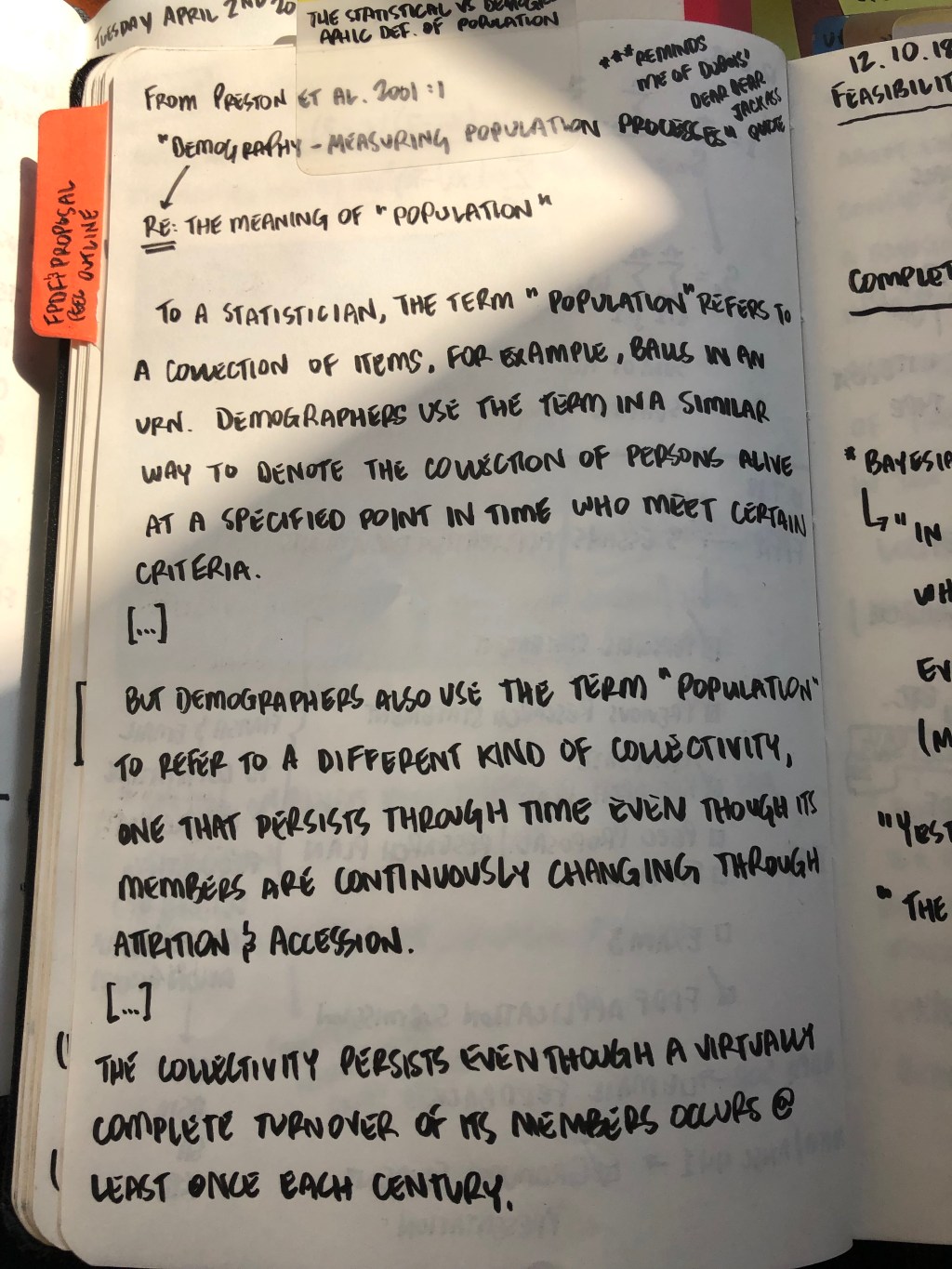
This article is short & informative about the abstract processes & assumptions involved in defining a population as a biological unit. One of the easier ways to make sense of this is to approach it from how statisticians define populations versus demographers. Below is a picture of one of my notebooks where I wrote down the definitions of population from Preston et al. (2001:1) “Demography – Measuring Population Processes”.

Gannet argues that populations are not mind-independent phenomena but instead are made based on context dependent inquiry that bounds genes in space & time. This understanding stems from what Gannet refers to as the “Mendelian” definition of population, deme, or isolate. Instead Gannet’s analysis reveals that defining a population requires that particular relations & degrees are privileged over others.
 Decolonize ALL The Things