
This month I focused on reading three books, “Troublesome Science – The Misuse of Genetics & Genomics in Understanding Race” by Rob Desalle & Ian Tattersall (2018), Londa Schiebinger’s book “Nature’s Body: Gender in the Making of Modern Science” (1993), & “The History of White People” by historian Nell Irvin Painter. Both Troublesome Science & Nature’s Body have similarities but are also starkly different. “Troublesome Science” is a continuation from Desalle & Tattersall’s 2008 book “Race: Debunking A Scientific Myth” where they went into depth reviewing the history of race as a product of the 18th century and Enlightenment along with debunking the claims of proponents of biological race concepts. Desalle & Tattersall base their argument on the science of taxonomy and systematics to demonstrate to readers that race is not biological. One of the main problems with such an argument is it relies on demonstrating what race is not, while also not demonstrating what race is and its effects on human health and wellbeing. This text, like many others, leaves a gaping hole in its argument and leaves readers to believe that race must be a social construction since it is not biological.
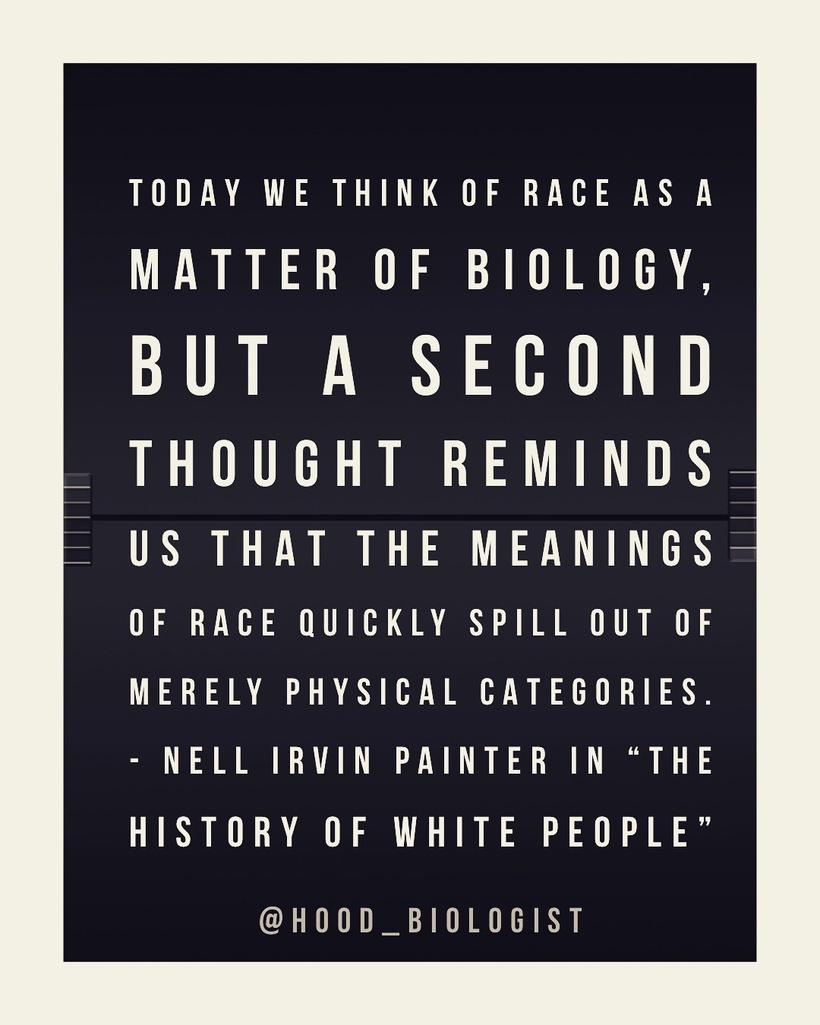
A book that does a good job demonstrating the different actions and work that went into the construction of whiteness through imperial and colonial rule is Nell Irvin Painter’s “The History of White People”. Painter opens up her book with a quote that stands out, demonstrating social construction by highlighting the act of racialization to dispel notions of biological race.
Historian Gerald Horne does an amazing job spelling out the conditions that formulated what he calls an ”alliance among Europeans of various class backgrounds” (2018: 23), what we today call ”whiteness”. It’s crucial that we recognize that whiteness is a way of being & rule rather than a set of phenotypes. Race doesn’t signify how people look but rather a categorical organizing system that came to divide humans based on the colonial means through which Europeans co-opted & dominated colonized peoples. This is what is mean by ”race is a social construct”, race is what historian & anthropologist Patrick Wolfe called ”colonialism refashioning itself” (2016). It’s a man made system which attached meaning to physical characteristics in response to justifying colonial domination, enslavement, & genocide.
Schiebinger’s book shares much in common with Painter’s text, both uncover a series of dynamic events made up of coordinated & uncoordinated actions. For example, Painter discusses the nitty gritty detailed & contradictory history of the social constriction of whiteness. This detailed analysis takes the reader through the history of Art, Beauty, Anthropology, and the collective histories of Europe. Painter illustrates how beauty rather than discrete anthropometrics are what constructed our understandings of human populations, used as secondary justifications for enslavement like those made by Thomas Jefferson. Schiebinger, on the other hand, reviews the history of natural history & biology, specifically Schiebinger is interested in understanding the intersections of gender, sex, & race in the process of scientific knowledge production. For instance, Linneaus centers the naming of mammals on the possession of mammary glands or the interestingly hilarious fact that he also thought plants had sex on a marital bed. He even thought there were monsters amongst men and included these creatures in Systema Naturae.
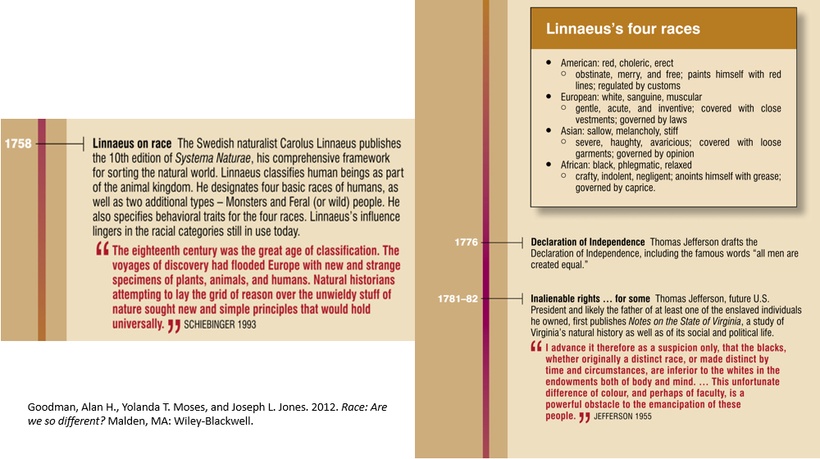
As Schiebinger notes, “That scientists might be unaware of the implications of their work does not make them any less mediators or marketeers of political ideas” (1993:8). The desire to conquer all of life bled into the very concepts we deem to be so rigidly objective.
 Decolonize ALL The Things