
INTRODUCTION
Can we talk about race without talking about racism and inequalities? To answer this question, we must first understand what ‘race’ is. To understand what race is requires that we understand it as a thing with a history, and within that context, we find not only its meaning but also the answer to this question. In the words of sociologist C. Wright Mills, “No social study that does not come back to the problems of biography, of history and of their intersections within a society has completed its intellectual journey” (2000:6). The historical development of ‘race’ itself provides not just sociologists, but members of any racialized society with a firm answer to this question but not via a clear “yes” or “no”. It requires that we look to the facts of history, that which actually happened. From there, we can understand the structure, processes, categorizations, events, and characteristics that have come to define ‘race’ in its historical context.
POSITIONS, PROCESSES, AND PROJECTS
‘Race’ is defined by its formation and the work that it does in human societies. With that being said, racial formation is central to understanding the relationship between ‘race’ and racism (Roberts 2011; Omi and Winant 2015). ‘Races’ are then better understood as what Patrick Wolfe (2016) referred to as “racialized distinctions” that speak of different relational histories and forms of displacement and dispossession. It is the social reproduction of ‘race’ itself that sustains and legitimates its status. Omi and Winant refer to ‘race’ as “a way of making people up” (2015:105). ‘Race’ is then a way or set of practices that should be understood as dynamic process-based projects. This processual project of ‘othering’ is itself racialization towards the logics of racism, what Patrick Wolfe (2016) referred to as colonialism speaking. Racial identities are constructed through the forces of colonial capitalist interests as well as collective group dynamics, Euro-Western colonial modes of meaning, happenstance, inertia, as well as contextual salience. As sociologist Herbert Blumer (1958) pointed out, ‘race’ can only be understood by looking at collective interactions and processes between racial groups as well as the processes through which racial groups come to define themselves and others. Blumer (1958) argues that part of the work of the scientific study of racial prejudice is seeking to understand how racist attitudes and feelings developed and are reproduced. ‘Race’ then can only be understood through investigating collective human interactions in the context of changes in social, political, and market forces over time (Cornell and Hartmann 2007).
RACIAL FORMATION THEORY
It was in 1662 that the Virginia colony in the Americas established partus sequiter ventrem, extending the free or chattel legal status of the mother to the child, extending slavery to all future matrilineal generations, in perpetuity (Sublette and Sublette 2016:135). At that time, ‘slave’ was not synonymous with African or Black, which began to rise in the 1650s in the colonies even during a time that European indentured servants were still being shipped to the West Indies (Wolfe 2016; Sublette and Sublette 2016). In 1691 there was the first legal use of ‘white’ when the Virginia colony enacted a law prohibiting the marriage between whites and Blacks (Goodman et al. 2012). We can keep following this path through the Civil War, the passage of the Black Codes during Reconstruction, the 15th Amendment, to the one-drop rule, and blood quantum. The point is that a ‘race’ is a political-economic grouping that serves political-economic functions and transforms its boundaries in different nations based on the interests of those in power (Roberts 2011). Later these political-economic relations transformed and were justified and framed as biological during the 18th century, and it was there that we began to see ‘race’ consolidate as the colonial system’s non-negotiable classificatory concept and organizing grammar of the 19th century. The order of these events is significant because what they reveal is ‘race’ is a political system regulating citizenship and labour. The problem of ‘race’ is a political, social, and economic one maintained through dynamic processes that reproduces the ideological justifications for Eurocolonial expansion and later a split labor market (Du Bois 1935; Bonacich 1972; Hill-Collins 2000). As sociologist Dorothy Roberts argues, “race is not a biological category that is politically charged. It is a political category that has been disguised as a biological one” (2011:4).
Blood quantum finds its origins in early 18th century US colonial expansion. Blood quantum was used to define Native Americans for the purpose of displacement and then deciding who would have access to ‘federal benefits’. Blood quantum wasn’t widely used till the Indian Reorganization Act of 1934. As stated by Dorothy Roberts, “It is in this acute distinction between the political status of whites and Blacks, this way of governing the power relationship between them, that we find the origins of race. Colonial landowners inherited slavery as an ancient practice, but they invented race as a modern system of power” (2011:12). What is key to recognize here is that the acute distinction between white and Black blood is central to the settler-native-chattel-immigrant relationship (Tuck and Yang 2010; Wolfe 2016).
The scales created to racialize African populations and frame Indigenous peoples as savage and permanently in the past are based on the one-drop rule to perpetuate settler colonial logics of elimination and the production of Black bodies for labor exploitation (Wolfe 2016). Skeletal anthropometrics and the one-drop rule came to define not just race but also: miscegenation. ‘Miscegenation’ in United States settler colonial politics also represented a biological evolutionary threat to white purity while simultaneously a crisis of governance requiring regulation (TallBear 2013). African blood represented a form of bestial non-humanity, somewhere lost in time between the human and primates while the blood of Indigenous peoples represented a bio-calculus prepped to be eliminated by the settlers (Wolfe 2016). In “1492”, Sylvia Wynter (1995) argues that miscegenation signifies the permanence of colonialism as well as its racial utopic vision where whiteness cleanses ‘lesser races’. Lighter skin and the notion of ‘we’re all mixed now’ signifies the land-bodiness and body-landedness of settlement. In this understanding, if bodies are colonized, then so are lineages (which is what partus sequiter ventrem did to enslaved African women) (Sublette and Sublette 2016). Wynter’s analysis of colonialism and racialization within the context of Christian philosophies underlies the importance of a specific kind of ‘family’ and a central nexus of the cultural hegemony of Europeans via Spaniard and Portuguese colonialisms. As Lowe argues, “Settlement, slavery, and colonial relations of production were conditions both for encounter and mixing and for the racial classifications that both denied and yet sought to organize such mixing” (2015:192). This relationship is one that sets the stage for the development of the racialized self and socially reproduces the racialization of others.
SOCIAL CONSTRUCTIONS, HISTORICAL GROUNDS
What do we mean when we say “race is a social construct”? Race is referred to as a social construct because of the ways that we come to answer questions of its origin, concepts of shared ancestry, and culture through the products of hegemonic group interaction. The collective histories of the formation of race are grounded in the social, economic, and political happenings of Euro-Western colonialism. This reasoning is complex and holds the many contingencies of human history and all the ways in which the logic of ‘biological race’ falls apart and fails to capture the dynamics of the human story. The logics, origin stories, categories, and meanings that the concept of race presents does not accurately represent the stories of the peoples it homogenously groups nor is it an accurate set of explanations for understanding human biology and genetics.
While “race is a social construct” has spread like wildfire in public discourse, its meaning is lost on the general public as well as among the academic community. Our collective practices on an everyday basis are still based on the logics of ongoing colonial hostilities rather than consciously developing a language and practice informed by the meaning of social construct based on the colonial historical formations of race/ism. The process of racialization and the set of practices, rules, and procedures that made and remake ‘race’ (racism) are lost in such statements. Few social scientists understand the ins and outs and meanings of the critique of biological race; they parrot statistical percentages from the Human Genome Project with little understanding of its meaning. Few natural scientists understand the context of the meaning of ‘social construct’ and can and have (as well as some social scientists) relegated their understanding of the social being biologically based. There is a cognitive dissonance in the contemporary scientific critique of ‘race’ when we separate it from its historical context and the power and command of resources that animates it: racism, colonialism speaking (Wolfe 2016).
“Race is a social construct” hasn’t gotten us very far. There are several reasons for this: the statement is not a finished project; it holds a lot of historical context, and people can and do hold that biology is the origin of race. It’s not that the social constructionist argument itself is flat-out wrong. Something more interesting is happening; our usage of it reveals some flaws. Let’s take the question of usage and meaning and apply it to the 1950 and 1951 UNESCO Statements on Race, where scientists and scholars ultimately introduced the scientific and public separation of race from racism (Happe 2013; Roberts 2011). This separation is important because it harbors the possibility of doing racialized work while claiming that you are not racist. This separation is the meat and bones of the conditions required for the flourishing of covert racism. Racism is left intact as a system able to generate social, political, and economic relations of colonial subjugation but with a new style. Most importantly, though, it legitimated the ahistorical claim of ‘racism as the product of race’.
Race/ism is a process of othering that occurs on the levels of the internalized racialized self, interpersonal racial relations, and institutional racialist patterns, and the collective dynamics of these leveled processes produce systemic outcomes based on the racialized rules about acceptable and unacceptable behavior that we are socialized in and react to. Scholars/scientists must be consciously aware of the ways in which they make up people in their own work. Racism is reified in the framings of race that separate it from racism and treat colonialism as an isolated set of events rather than an ongoing process central to contemporary relations. Consequently, the mainstream critiques of race often exist amongst flourishing notions of racial biological essentialism rather than furthering its abolition.
What race is descriptively also includes its prescriptive (what ought to be); its categorizations inform practices that sustain and reproduce racism. Central to race is the work it does in institutionally, interpersonally, and individually coordinated ways. Race was designed as a tool to fit the uses and interests of colonial capitalism (resource and settler), extending from imperial hostilities and resistance to settler colonial planters and slave traders. Colonial processes are at play even though we tend to be distracted by its many other names under the guise of assimilationist projects, civic nationalism, industrialism, and finance capitalism (Wolfe 2016; Dunbar-Ortiz 2014; Bhambra 2014). The formation of race/ism is molded by responses to market-based logics and the interests of the few who had private ownership and command over expansive resources (Baptiste 2014).
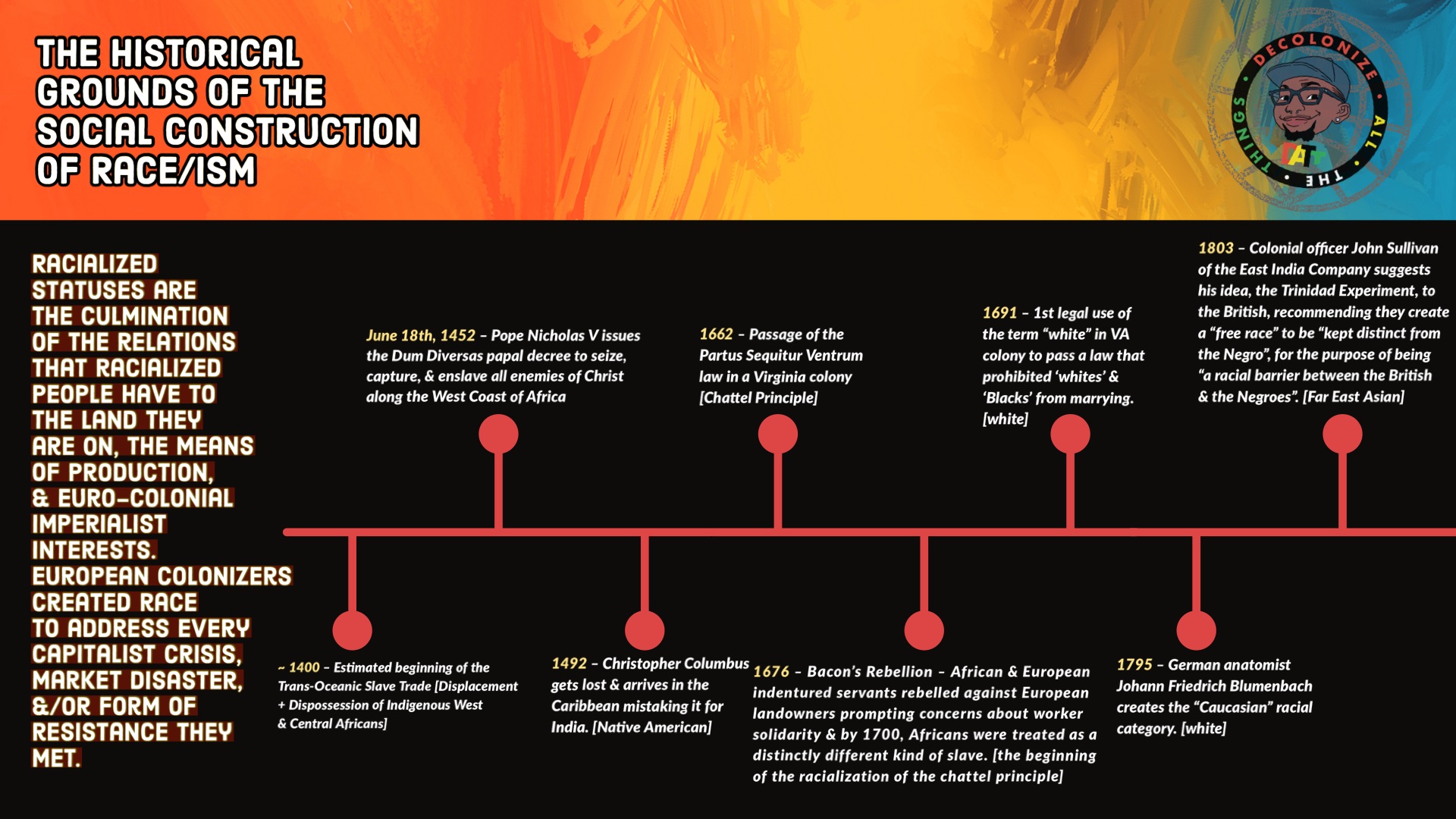
RACE IS ALWAYS RACISM
Race is a product of racism, always (Roberts 2011; Omi and Winant 2015; Wolfe 2016). Race as a set of classificatory regimes is not limited to its doctrines but is also a set of practices that seeks to maintain group-specific modes of colonial domination (Wolfe 2016). The ways in which we collectively use ‘race’ academically, publicly, and privately fails to effectively communicate this meaning. This requires a racial formation theory that does not legitimate the Euro-Western colonial epic of “we made this land” (Fanon 2004). An understanding of history that is dynamic and processual is required in mainstream racial formation theory, and it requires a settler colonial critique and a more expansive evolutionary understanding of time, processes, and history. A settler colonial consciousness requires that we trouble the categorizations of ‘problematic beings’. The inequalities that we see are reproduced, and ‘race’ is a colonial doctrine formed to justify and normalize exploitative relations. Racial formation theory then requires a de-normalization of the American Dream, the Last Mohican narrative, and the one-drop rule.
Exposing ‘race’ as what it is means exposing racism. The utility of ‘race’ is its stabilization of colonial and imperial power amassed through historical and ongoing displacement and dispossession in an expanding processual global fashion. As Dorothy Roberts points out, “the very first step of creating race, dividing human beings into these categories, is a political practice” (2011:4). Liberal niceties and intentions were no match for state-sanctioned ‘race’ geneticization nor the continued use of biological essentialism in the natural, social, and applied sciences (Roberts 2011; Happe 2013; Morning 2008). ‘Race’ continues to have a grand utility because it serves the social, political, and economic interests of dominant groups over time (individuals and institutions) (Doane 1997). The profitability of racism is central to the preferred reliance upon it as a normative procedural practice, whether it be through cultural reductionist determinism, biological essentialism, or colorblind argumentation.
REFERENCES
Baptist, Edward E. 2016. The Half Has Never Been Told: Slavery and the Making of American Capitalism. New York: Basic Books.
Bhambra, Gurminder K. 2014. Connected sociologies. London: Bloomsbury Academic.
Blumer, Herbert. 1958. “Race Prejudice as a Sense of Group Position.” The Pacific Sociological Review 1(1):3–7.
Bonacich, Edna. 1972. “A Theory of Ethnic Antagonism: The Split Labor Market.” American Sociological Association37(5):547–59.
Cornell, Stephen E. and Douglas Hartmann. 2007. Ethnicity and race: Making identities in a changing world. Thousand Oaks, Calif., London: Pine Forge Press.
Doane, Ashley W. 1997. “Dominant Group Ethnic Identity in the United States: The Role of “Hidden” Ethnicity in Intergroup Relation.” iterly 38(3):375–97.
Du Bois, William E. B. 1998. Black Reconstruction in America: [1860 – 1880]. New York, NY: The Free Press.
Du Bois, William E. B. 1898. “The Study of the Negro Problems.” Annals of the American Academy of Political and Social Science. 11:1-23.
Dunbar-Ortiz, Roxanne. 2015. Indigenous Peoples’ History of the United States. Boston: Beacon.
Fanon, Frantz and Richard Philcox. 2004. The Wretched of the Earth. New York: Grove Press.
Happe, Kelly E. 2013. The material gene: Gender, race, and heredity after the human genome project. New York: New York University Press.
Hill Collins, Patricia. 2000. Black feminist thought: Knowledge, consciousness, and the politics of empowerment. New York: Routledge.
Jackson, John P. and Nadine M. Weidman. 2005. Race, racism, and science: Social impact and interaction. New Brunswick: Rutgers University Press.
Lowe, Lisa. 2015. The Intimacies of Four Continents. Durham: Duke University Press.
Morning, Ann. 2008. “Reconstructing Race in Science & Society: Biology Textbooks, 1952-2002.” American Journal of Sociology 114(Suppl.): S106-S137.
Omi, Michael and Howard Winant. 2015. Racial formation in the United States. New York: Routledge.
Roberts, Dorothy. 2011. Fatal invention: How science, politics, and big business re-create race in the twenty-first century. New York: New Press.
Sublette, Ned and Constance Sublette. 2016. The American slave coast: A history of the slave-breeding industry. Chicago, IL: Lawrence Hill Books.
TallBear, Kim. 2013. Native American DNA: Tribal Belonging and the False Promise of Genetic Science. Univ Of Minnesota Press. Kindle Edition.
Tuck, Eve and K. W. Yang. 2012. “Decolonization is not a metaphor.” Decolonization: Indigeneity, Education & Society1(1):1–40.
Wolfe, Patrick. 2016. Traces of history: Elementary structures of race. London: Verso.
Wynter, Sylvia. 1995. “1492: A New World View”. In: Race, Discourse, and the Origins of the Americas, ed. by Vera Lawrence and Rex Nettleford (Washington: Smithsonian Institution Press, 1995), 5–57.
 Decolonize ALL The Things