
What is GENDER?
Gender is the range of mental and behavioral characteristics pertaining to, and differentiating between, across & beyond masculinity and femininity. In Western societies, the accepted cultural perspective on gender views women and men as naturally and unequivocally defined categories of being with distinctive psychological & behavioral propensities that can be predicted from their reproductive function. (The idea that women do feminine things, men do masculine things & it is just ‘natural’) (Doing Gender, West & Zimmerman, 1987:126)
What is SEX/BIOLOGICAL SEX?
Sex is a determination made through the application of socially agreed upon biological criteria for classifying persons as females or males. The criteria for classification can be genitalia at birth or chromosomal typing before birth, and they do not necessarily agree with one another (Doing Gender, West & Zimmerman, 1987:127).
What is SEX CATEGORY?

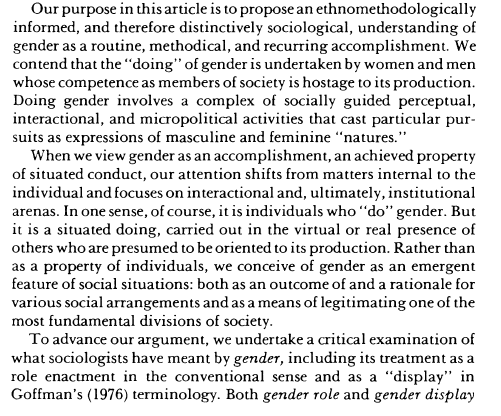
Placement in a sex category is achieved through the application of the sex criteria, but in everyday life, categorization is established and sustained by the socially required identificatory displays that proclaim one’s membership in one or another category. Sex & sex category can vary independently; that is, it is possible to claim membership in a sex category even when the sex criteria are lacking (Doing Gender, West & Zimmerman, 1987).
What is PATRIARCHY?
Patriarchy, better known as fatherdom, is a social system that valorizes the cultural belief of the authority & claims of fathers over mothers, children & the weak (Laqueur 1992). Patriarchy is a social system in which men are the primary authority figures central to social organization & the central roles of political leadership, moral authority, & control of property, & where fathers hold authority over women & children. It implies an institution of ‘male’ rule & privilege, & entails ‘female’ subordination. Many patriarchal societies are also patrilineal, meaning that property & title are inherited by the male lineage. Patriarchy can manifest itself socially, politically, & economically.
The idea that biologically based “sex differences” are responsible for producing gender & sex inequality is a Eurocolonial patriarchal claim that developed in the 18th century. It is NO mere coincidence that this coincides with the development of “race” as a scientific classificatory concept in the late 18th century. Eurocolonialism recruited biology as the ideological basis & legitimating rationale to justify exploitation via racism, patriarchy, capitalism & ableism.
Eurocolonial sociopolitical interests fuel the idea that “biological differences” are foundational wounds producing human social problems. Prior to the 18th century, Europeans utilized a one-sex model with at least two genders, social positions for the purpose of culturally asserting patriarchy, the rule of the father (Laqueur 1992). With no awareness of “sexual dimorphism” (distinctive to the two-sex model), European patriarchy developed “gender” as a hierarchical sociopolitical category.
Patriarchy/ Fatherdom is a system of domination its claims are cultural myths & dominant ideologies about securing inheritance & establishing power relations in the interest of fathers during early developments of private property. Patriarchy/Fatherdom is not an original order, it does not originate nor have its basis in nature, & it’s claims & ideologies have nothing to do with biology nor securing the safety of family & everything to do with dominating those around you.
What is cisheteropatriarchy?
A system of power based on the supremacy & dominance of cisheterosexual men through the exploitation & oppression of women and LGBTQIA* people. Also referred to as sexism. This includes oppressive constructs such as homophobia, transphobia, biphobia, etc..
What do dominant gender norms, sex categories, & sex criteria under patriarchy result in?
A heteronormative society where any sexual or gender expression that is outside of the binaries of masculine-feminine & man-woman are subjugated resulting in heterosexual normative privilege for those who follow the systemic and social scripts of patriarchy & biological determination (the idea that biology naturally drives sex, gender, & sexuality).
Understanding African Gender Ideologies
The concept of “gender” only being a binary is European. Oyewumi (The Invention of Women by Oyeronke Oyewumi, 1997) demonstrated that the “woman question” is inherently Western, one that did not exist in pre-colonial African societies. African societies did not have conceptions of what we conceive of as ‘gender’ prior to colonial contact. For example, in old Yoruba society, gender was NOT constructed via a binary and social organization was determined by relative age.
Hegemonic Masculinity
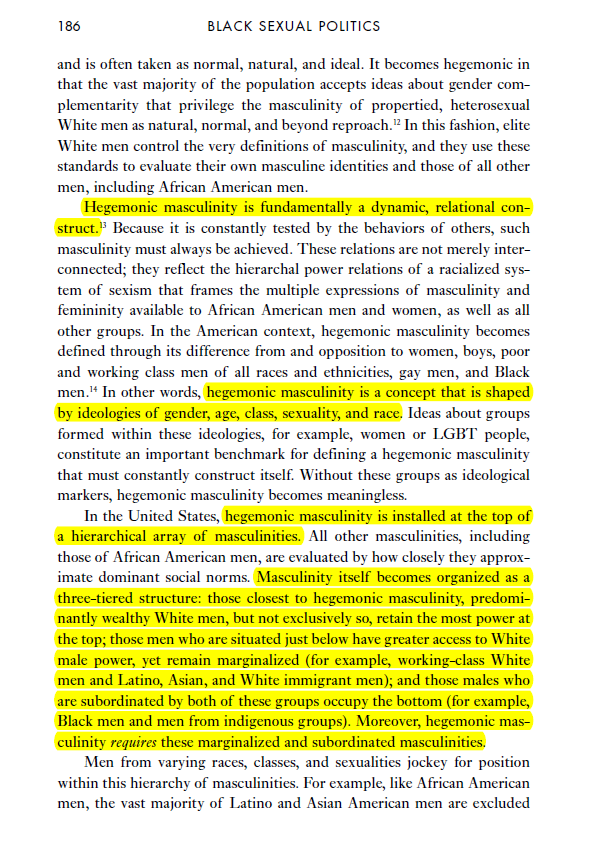

Hegemonic masculinity is the gender practice that guarantees the dominant social position of men and the subordinate social position of women & other non-men people. Conceptually, hegemonic masculinity explains how and why men maintain dominant social roles over women, and other gender identities, which are perceived as “feminine” in a given society. As a sociologic concept, the hegemonic nature of “hegemonic masculinity” derives from the theory of cultural hegemony, by Antonio Gramsci, which analyzes the power relations among the social classes of a society; hence, in the term “hegemonic masculinity”, the adjective hegemonic refers to the cultural dynamics by means of which a social group claims, and sustains, a leading and dominant position in a social hierarchy; nonetheless, hegemonic masculinity embodies a form of social organization that has been sociologically challenged and changed.
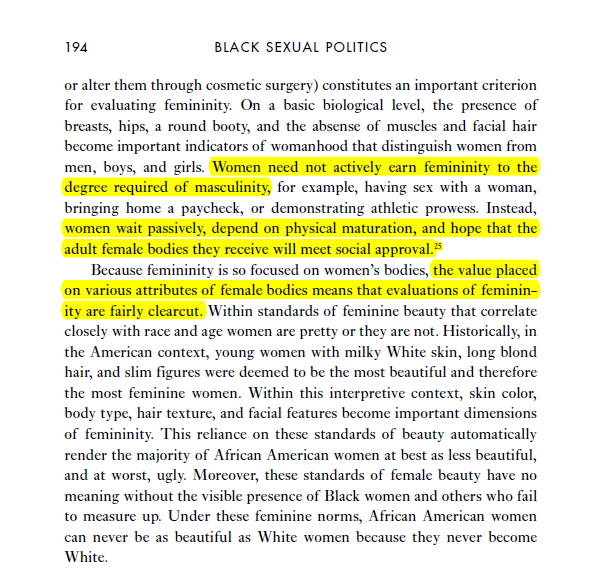
Hegemonic masculinity construction relies on a binary of what the female/woman is or is not. Hegemonic masculinity in a patriarchal system is a very active status. Men have to prove that they are not women while women align with hegemonic femininity via passive forms of waiting on physical maturation & hoping that their bodies receive social approval. One of the benchmarks of hegemonic femininity is that women must not be like men & Black women automatically break that rule. For a long time the Black community’s problems have been blamed on one dynamic: Black men are too weak, & Black women are too strong. (Black Sexual Politics by Dr. Patricia Hill-Collins pp.185-199)
Hegemonic Femininity
Unlike Hegemonic masculinity, Hegemonic femininity is passive, requiring that women not act to earn femininity. Women wait and depend on their physical maturation and hoping their body fits the Euro-American beauty standard so that they can meet social approval. One of the cores to both hegemonic masculinity and hegemonic femininity is biological determinism/naturalism: the idea that there are innate natural characteristics that we have that determine our gender (feminine & masculine) characteristics (Black Sexual Politics by Dr. Patricia Hill-Collins pp.185-199). Zimmerman & West’s (1987) work reveals that gender is a social, political, and economic construct. Gender is a performance. As a hegemony, patriarchy dictates the rules and boundaries by which those performances are defined.


The reality is what we see as natural about gender is actually a performance. We have all been socialized into performing these cishetnormative ideals of what men and women are supposed to do and these ideas serve the purposes of continuing the hegemony cishetpatriarchy.
What is also crucial here that Dr. Hill-Collins points out is the intersections of gender, sexuality, class, and race. These drastically alter the meaning and ways in which gender is performed. Masculinity means something different for an underclass Black man versus an upper middle class Black man.
Some Books on Patriarchy & Gender:
Black Sexual Politics by Patricia Hill-Collins
The Invention of Women: Making an African Sense of Western Gender Discourses by Oyeronke Oyewumi
Indigenous Men & Masculinities: Legacies, Identities, & Regeneration by Warren Cariou et al. (2015) [This is an edited volume]
Also check out the Black Feminist Reading List Here
Read “Issues of Power, Not Bathrooms”
Making Sex: Body & Gender from the Greeks to Freud by Thomas Laqueur (1992)

